
How to Calculate As-Is Property Value: 5-Step Guide
Learn how to calculate as-is property value with comps, adjustments, and repair costs. Follow our step-by-step guide to price offers with confidence.

Knowing how to calculate as-is property value is the skill that separates profitable investors from those who overpay. As-is value is what a property is worth today, in its current condition, before any repairs. Get it wrong and you either kill your margin or lose the deal. This guide walks through a repeatable method you can run on any address.
Quick answer: Find recent sold comps in similar condition, adjust them for differences, then cross-check by subtracting repairs and costs from the After Repair Value (ARV). The result is your as-is value.
What Is As-Is Property Value?
As-is value is the price a typical buyer would pay for a home in its present state. It accounts for worn systems, cosmetic damage, and deferred maintenance. In contrast, ARV is the expected value after renovation.
Investors need both numbers. ARV shows the upside, while as-is value shows what the property is worth right now. For more on the upside side of the equation, see this step-by-step ARV guide.
An investor compares sold properties to work out how to calculate as-is property value.
Why As-Is Value Matters for Offers
Sellers of distressed homes rarely accept a retail price. Therefore, your offer must be anchored to what the home is worth in its current state. An inflated as-is number leads to overpaying. A number that is too low means lost contracts.
Wholesalers also use it to defend offers. A clear, documented number makes conversations with sellers and cash buyers easier. If you work with wholesale math, this wholesale MAO calculator guide shows how the pieces fit together.
How to Calculate As-Is Property Value Step by Step
Follow this process on every deal. It takes about 45 minutes by hand when you are learning, and less with practice.
- Pull recent comparable sales. Find three to six sold homes within about a mile, sold in the last six months, with similar size, age, and style.
- Match condition. Separate renovated comps from unrenovated ones. Your distressed subject should be compared to homes in similar shape.
- Adjust for differences. Add or subtract value for square footage, bedrooms, bathrooms, lot size, and features.
- Calculate ARV and estimate repairs. Average the adjusted renovated comps for ARV. Then total the repair scope and add a contingency.
- Subtract costs and cross-check. Compare the unrenovated-comp value with ARV minus repairs and costs. If they differ widely, revisit your inputs.
Choosing Comparable Sales That Hold Up
Good comps are the foundation. Proximity, recency, and condition matter most. In addition, match property type and school or neighborhood boundaries when possible.
Avoid cherry-picking. Comps that happen to support a number you want will not survive a buyer's scrutiny. The comparative market analysis method rests on consistent, honest selection.
Two Ways to Find As-Is Value
There are two common approaches. Using both gives you a built-in check.
| Method | How it works | Best used when |
|---|---|---|
| Direct comparison | Adjust unrenovated sold comps to match the subject | Many similar distressed sales exist |
| ARV minus costs | Start with ARV, subtract repairs, holding, and selling costs | Few unrenovated comps are available |
The second method is a formula: as-is value is roughly ARV minus repair costs minus holding and selling costs. Investors often subtract a profit margin too, but that gives an offer price rather than market value.
Estimating Repair Costs Accurately
Repairs are the biggest swing factor. Walk the property room by room, then list roof, HVAC, plumbing, electrical, kitchens, baths, flooring, and paint. Get contractor quotes where you can.
Always add a contingency, often 10 to 20 percent. Scope also changes after a walkthrough. For example, ChatARV user Chris Turney updated a report after finding a property needed a full gut, and it recalculated instantly to $88k, which helped him renegotiate and land a $35,000 assignment fee.
Common Mistakes to Avoid
- Using renovated comps without adjusting for condition.
- Relying on automated estimates that cannot see the interior.
- Skipping a repair contingency.
- Using stale or distant sales.
- Making very large adjustments, which signal a poor comp.
Percentage assumptions matter too. This explanation of value increase after repairs helps you sanity-check the gap between as-is and ARV.
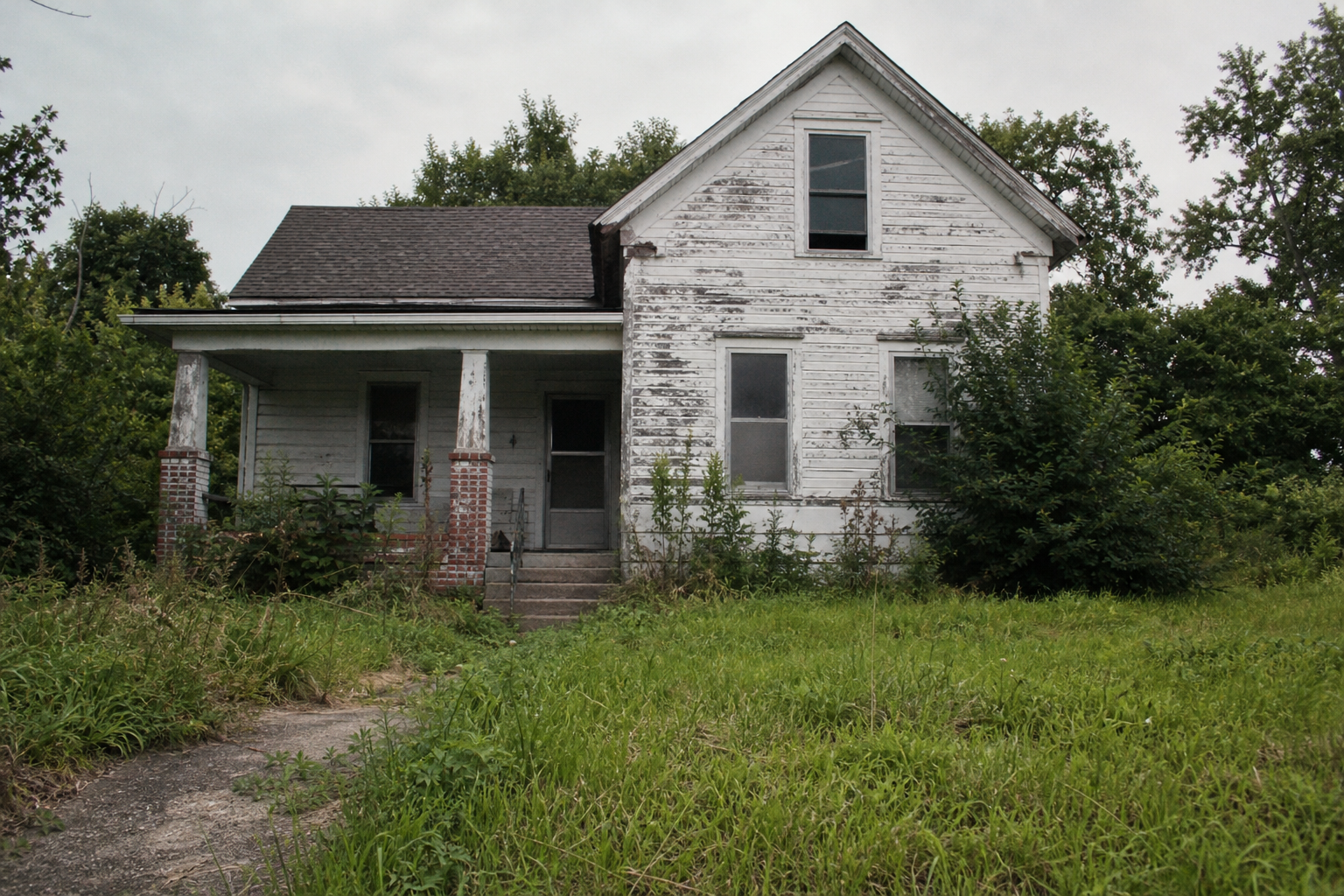
A distressed house like this is priced by its current condition, not its renovated potential.
Speeding Up the Process With AI
Manual comping can take 20 to 30 minutes per property. That is slow when a seller is on the phone. ChatARV is an AI deal-analysis platform for wholesalers and investors that finds comps, calculates ARV and as-is value, estimates repairs, and produces offers in about 60 seconds.
Reports show the comps used and every adjustment, so you can defend the number. You can toggle comps, add your own, and recalculate when repairs change. It also supports all 12 non-disclosure states. For a deeper look, read this as-is value calculator guide.
Frequently Asked Questions
What is as-is property value?
As-is property value is what a property is worth today in its current condition, with no repairs or upgrades. It reflects what a buyer would realistically pay for the home as it stands.
What is the simplest way to calculate as-is property value?
Compare your property to recently sold homes in similar, unrenovated condition and adjust for differences. Alternatively, start from ARV and subtract repair costs and a margin for holding and selling expenses.
How is as-is value different from ARV?
ARV is the expected value after renovations. As-is value is the current value before any work. The gap between them is driven mostly by repair costs and risk.
Can I use a Zestimate as the as-is value?
No, treat automated estimates as a rough starting point only. They often cannot see interior condition, so they may overstate the value of distressed homes.
How many comps do I need?
Three to six good comps is a common target. Quality matters more than quantity, so prioritize proximity, recent sale dates, and similar condition.
How recent should comparable sales be?
Aim for sales within the last three to six months. In fast-moving markets, use the most recent data available.
How do repair costs affect as-is value?
Higher repair costs lower as-is value because a buyer must fund the work. Always add a contingency, often 10 to 20 percent, for surprises.
Does an appraiser calculate as-is value differently?
Appraisers use the same sales comparison logic but follow formal standards and document adjustments. Investors usually move faster and add a profit margin.
How do I find as-is value in non-disclosure states?
Sale prices are not public in these states, so you need MLS-sourced data or agent help. Tools such as ChatARV support all 12 non-disclosure states.
How does as-is value relate to MAO?
Wholesalers typically calculate Maximum Allowable Offer from ARV, repairs, and desired profit. Your as-is value is a useful sanity check on that number.
What are common mistakes when calculating as-is value?
Common errors include using renovated comps without adjusting, ignoring repair contingency, and using old or distant sales. Overly large adjustments are another warning sign.
How long does it take to calculate as-is value?
Manually it can take 20 to 30 minutes per property. AI tools like ChatARV can produce an analysis in about 60 seconds.
Conclusion
Learning how to calculate as-is property value comes down to a few habits: choose tight, recent comps in similar condition, adjust them carefully, estimate repairs with a contingency, and cross-check with ARV minus costs. Do this consistently and your offers become both competitive and defensible. Whether you work by hand or use a tool like ChatARV, a documented method protects your margin on every deal.
